
I'm excited to have an article in this month’s St. Anthony Messenger entitled “10 New Ways to Pray.”
I also have a reflection coming out in Magnificat in January!
My 2017 Lent Retreat at the Caritas Christi Center in Hamden, CT is on Mar. 18 if you want to save the date. I am thinking of doing something on prayer. If you have any ideas or suggestions, now's the time to tell me!
A few of you contacted me and said you were having trouble accessing the “Comments” section for the “Friends with God?” blog post. Here’s how to find it: Go to my blog page (www.amyekeh.com/blog). Scroll down until you see the post “Friends with God?” At the end of the post (under the words “Now go ponder!” on the left side), you will see (in fairly small text) something like “19 Comments.” Click on those words to read the comments. Thank you again for your wonderful contributions and your interest in one another's ideas!
- In other news, for those in the Archdiocese of Hartford seeking more information about annulments, especially in light of the changes initiated by Pope Francis, please see the information below about an upcoming series that is designed to guide folks through the process. The series begins on Sep. 15 at the Church of the Assumption in Woodbridge and continues with writing workshops. The main speaker on Sep. 15 will be Fr. Juan-Diego Brunetta, O.P., Judicial Vicar of the Metropolitan Marriage Tribunal of the Archdiocese of Hartford. Please click the document below for more information:
Your Thoughts on Friendship with God
What a wonderful week of hearing from many of you on the blog, by email, on facebook and even in person about your reflections on friendship with God. I learned so much from and about you. I want to thank Burr Datz for getting us started. Burr, you’re the best.
I hope many of you will enjoy reading what others thought about this topic by clicking on “Comments” below last week’s post “Friends with God.” You’ll find a variety of thoughts and some really interesting connections, distinctions and personal convictions. Thank you all for your thoughtful responses. (Those of you who responded by email and facebook, I’ve collected your responses and posted them there anonymously.)
Next week, I'll offer a few of my own thoughts based on some Scripture passages that have deeply impacted me along the way.
In the meantime, I’m not sure I could say it better than Jim Tottenham, who posted for us this series of questions to ponder as we ask ourselves what friendship is, and how it affects our understanding of being friends with God:
“Being a friend of God is an awesome question. I think about what that personally means to me and ask myself what it means to be a friend and does this apply to being God’s friend:
Do I stay in touch on a regular basis?
Do I put my trust in him?
Would I let him take any of my treasured possessions?
Would I rely on my friend to do the same for me as I would do for him?
Would I intentionally do anything to harm him in any way?
Would I drop everything and go with him if he needed me?
Would I defend his name if he was falsely accused of something?
Would I tell others about him and what he means to me?
Would I easily introduce him to others and not worry about their reactions?
Would I always believe in him?
Would I never abandon him?
Would I give my life for him?”
Friends with God?
This week I’d like to hear from you. Yes, I’m finally giving you a turn to talk.
I’d like to know how you would answer this question:
Can we can be friends with God?
It’s easy to quickly answer “yes” to this question. I’m thinking of those great bumper stickers that say “My best friend is a carpenter.” But I want you to think about what friendship is. How would you define it? Reflecting on this definition, are you and God “friends”? Or is the nature of your relationship with God something else entirely?
I hope some of you will share your thoughts with others by clicking on "Comment" below and jotting down a few ideas. (For those of you who receive the blog by email, you can leave a comment by clicking the title of today’s blog, which will take you to the blog page, where you can click on the word "Comment" below the blog post. Or if you prefer to be anonymous but still want to join the conversation, you may simply “reply” to this email and respond to me privately.)
In the next blog post, we’ll reflect on some of your responses and on several pertinent Scripture verses.
Now go ponder!
Living a Hidden Life
I recently came across an article by Fr. David May, a priest of Madonna House, the apostolate founded by Catherine Doherty. I asked permission to share it here because I thought it would speak to many of you.
As human beings, I think we have a natural desire for greatness. Of course, greatness can be defined in many ways. In this article, Fr. David May describes the greatness of an ordinary life, the kind of life Jesus lived during those hidden years in Nazareth, the kind of quiet, ordinary life that most of us lead every day.
Fr. May describes six joys of Nazareth – six challenges of our ordinary lives – and encourages us to embrace this path of love and thereby embrace Christ himself. As the Gospels tell us time and again, it is the small things that have the potential to be great.
Thank you to Fr. David May and Madonna House Publications for sharing this reflection with us.
* * * * *
“The Joys of Nazareth”
By Fr. David May
Society offers us many “joys.” We are all too familiar with them, sometimes to our embarrassment as Christians. The media proposes to us the joys of material prosperity and the joy of being young, athletic, and popular. We are invited to reach for the joy of the ever better, the ever exciting, the ever new experience.
There is an unceasing search for the joy of the perfect relationship—the mirage of being perfectly understood. Others invest their energies in the joy of power over others or in enjoying various pleasures with reckless abandon. Many admire the one who rejoices in being “cool” and “always in control” of his destiny. We think, If only I could be so self-assured.
A Christian is called to live joyously, but he rejoices principally in the Lord who loves him and saves him. When we say to the Lord, You are my joy, my happiness lies in you alone, he smiles upon us with great tenderness. And he offers us some treasures straight from his heart, treasures which I call “the joys of Nazareth.”
1. Going unnoticed
First, there is the joy of going unnoticed. You know, you pour yourself out preparing a lovely meal, weeding the garden, putting in extra time at work or at the parish—and no one notices. You hardly get a perfunctory “thanks.” You find yourself taken for granted like the proverbial old shoe.
Whoever notices an old shoe anyway? You put it on, it serves you quietly and without fanfare, and when you’re finished with it, you toss it under the bed or into the closet. You never give it a second thought, let alone a fresh coat of polish! And your Father who sees all that is done in secret will reward you (Mt 6:4).
2. Being noticed at the wrong time
And then there’s the joy of being noticed—at the wrong time! Just when you’re at your very worst—losing your temper, putting a dent in the car, burning the bacon, saying something foolish—then everybody notices!
Suddenly you become the center of conversation, or at least of sideways glances. The spotlight is now on you. And so you stand there, naked, your weaknesses exposed, not only to yourself (bad enough) but to others (humiliating). Family life in particular is chocked full of such fare.
Rejoice, blessed one, you have just received the second joy of Nazareth!
3. Boredom
Third, there is the joy of being bored. Nazareth is by nature a series of many monotonous moments: feeding the little ones, peeling the spuds, emptying the trash, swishing out the toilet bowl, fixing the car. All of these are daily fare, hardly scintillating in themselves. But monotony is also a treasure for those with eyes to see. Repetition offers our hearts and minds the freedom to pray. For example, the Jesus prayer: “Lord, Jesus Christ, Son of the living God, have mercy on me, a sinner.” This prayer allows us to enter as little children into the heart of God. Repetition is an occasion to purify our hearts of useless noise and to enter into silence.
Few seem aware of this, but it is true. And boredom offers us yet another gospel gem: the chance to act out of love alone, with no other apparent compensation.
4. Your time is not your own
Another joy of Nazareth is that of not having time to do what we would like. Just when you have set aside those precious few hours or minutes for yourself to read that book, enjoy your hobby, listen to music, pray, or just sit quietly, the roof, so to speak, caves in. There is a crisis, someone needs immediate attention, the plumbing bursts, the roast is sizzling into ashes, etc., etc.
The days go by and run into months and years of this. I have no time for myself any more. My own life is not even my own! But it is then that the Lord smiles upon us, and the words of St. Paul can rise up from our hearts: I live now not with my own life, but with the life of Christ who lives in me… I cannot bring myself to give up God’s gift (Gal 2:20-21).
5. Misunderstandings
The fifth joy of Nazareth is that of not being perfectly understood. Perhaps you have had the experience. Even those who love us most dearly and know us the best, often do not really grasp the deepest movements of our hearts. This can be a shock at first, a source of bitter disappointment as time goes on. But it can also be a joy if we use such painful moments to enter the bittersweet world of our solitude.
And what do we learn there in the heart of loneliness? We learn that we are made for God alone, and that he alone knows us as we long to be known. And he alone loves us as we long to be loved.
6. Interruptions
The sixth joy of Nazareth is that of being fragmented and dispersed by the demands of life. We are pushed and pulled this way and that, seldom getting anything done the way we had intended. In fact, life seems to be a great series of unfinished projects. For those who love order, this can be excruciating.
A greater pattern
But gradually we come to see that our life is part of a greater pattern whose magnificent dimensions are beyond our ability to grasp. It is our Father who is the Source of this plan. He asks us to be content to be nourished by him moment by moment. The Bread he offers us is Jesus himself, who will teach us to trust and to be a child. In him, after all, all things hold together (Col 1:17).
The ultimate joy of Nazareth is, of course, you and me—us—together, not in the greeting card sense of such terms, but in the bare-boned reality of our call to live together as families of love in all our poverty and in all our glory.
The great miracle
Union in love is, was, and always will be the great Christian miracle, the one for which Jesus prayed so earnestly: so that my own joy may be in you and your joy be complete. This is my commandment: love one another as I have loved you (Jn 15:11-12).
Such love is the flowering of God’s life within us, rooted in the good soil of hearts made great through embracing the ordinary. For, wonder of wonders, when we embrace the everyday “joys” of Nazareth, it is the Lord himself whom we embrace.
Originally published in Madonna House's publication "Restoration," January 2005. Shared here with permission.
To find out more about Madonna House, click here. To visit Madonna House Publications, click here.
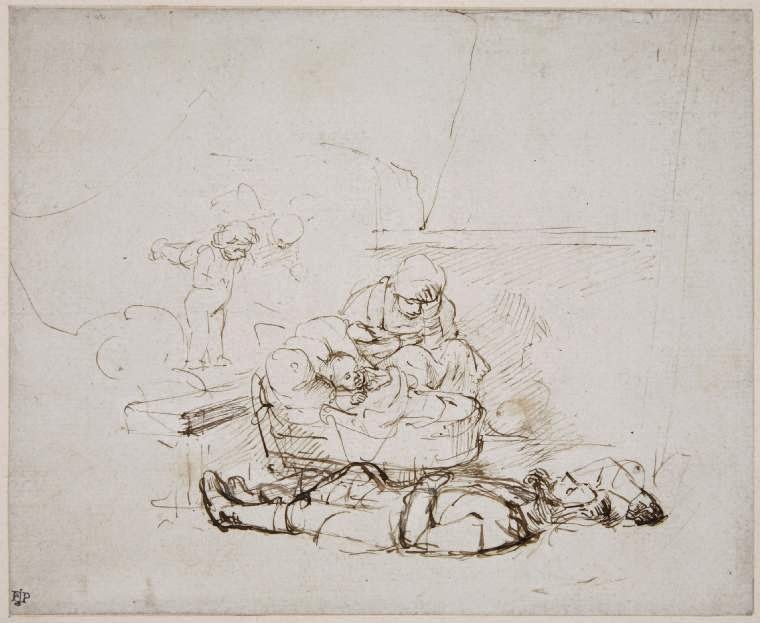
The Holy Family Sleeping, with Angels, Rembrandt van Rijn, pen and brown ink on paper, 1645.
The Sacred Dynamic of Frank Conversation
Last Sunday’s Gospel reading was the familiar story of Martha and Mary (Luke 10:38-42). As the reading began, I wasn’t expecting to hear anything new. I know this one; I know the words of Jesus; I know the lesson.
But I was blessed to be surprised. I was surprised by the words of Martha. Not because she sounded distressed, or frustrated, or annoyed with her sister. I wasn’t surprised by her resentment or even her logic.
I was surprised by how bold she was with Jesus, how frank, how confident.
Thinking back over the Gospels, there were many people who were quite deferential toward Jesus. They spoke and acted with fitting respect for the masterful teacher and wonder-worker he was. But there were others who were surprisingly informal with Jesus. Perfect strangers approached him – they asked him for things, they touched him, they laid their heaviest burdens on him. Indeed, many who approached Jesus did not just ask; they commanded! Remember Jairus: “My daughter is at the point of death. Come and lay your hands on her” (Mk. 5:23) or Bartimaeus of Jericho: “Let me see again” (Mk. 10:51).
Martha’s command was just as direct: “Tell her to help me.”
Certainly the presence of Jesus made people take notice. There was charisma, authority, even power over the natural world. But apparently he was not intimidating. There was something about his presence that drew people close, unmasking them and inviting frank conversation and bold requests.
Now of course, when we are frank and bold with Jesus, he may be frank and bold with us. Martha may not have liked Jesus’ gentle rebuke. But John’s Gospel tells us that Jesus loved her (Jn. 11:5), and she certainly knew that. There was no need for Martha to hide her heart from Jesus. The honesty, the unmasking, is what allowed Jesus to penetrate that heart, to love it and transform it. This is the power of honest prayer, the sacred dynamic of frank conversation.