
The Last Gift of Christmas

Some of you may remember this story from years ago. It brings back good memories for me of days when my children were younger, and interesting things showed up in our manger scene all the time. What gift will we bring the Christ child as his drawing-near expands our hearts? What sacrifices will we make for the sake of love? Merry Christmas, all, and every blessing in 2026!

The Last Gift of Christmas


This year, the last gift of Christmas was a Starburst.

Even more impractical than gold, frankincense, and myrrh was this gigantic chunk of sugar and food coloring left for a baby with no teeth.

Some years, Lego figures visit our manger. One year a tiny skateboard waited in the stable, in case Jesus wanted to ride it later. Barbie probably would have gone in too if she wasn’t so tall. But this year, just when I thought no one was paying any attention to the manger, the last gift of Christmas was left for the baby.

Not the yellow Starburst that no one wants. The red Starburst, the prize.

May the last gift of Christmas always be for the child in the manger. If it hurts a little to give it, then we know it came from deep within, from a place that wants more than what this world can give. And whatever we give him, may it come back to us in good measure—packed together, shaken down, overflowing, poured into our laps (Luke 6:38)!
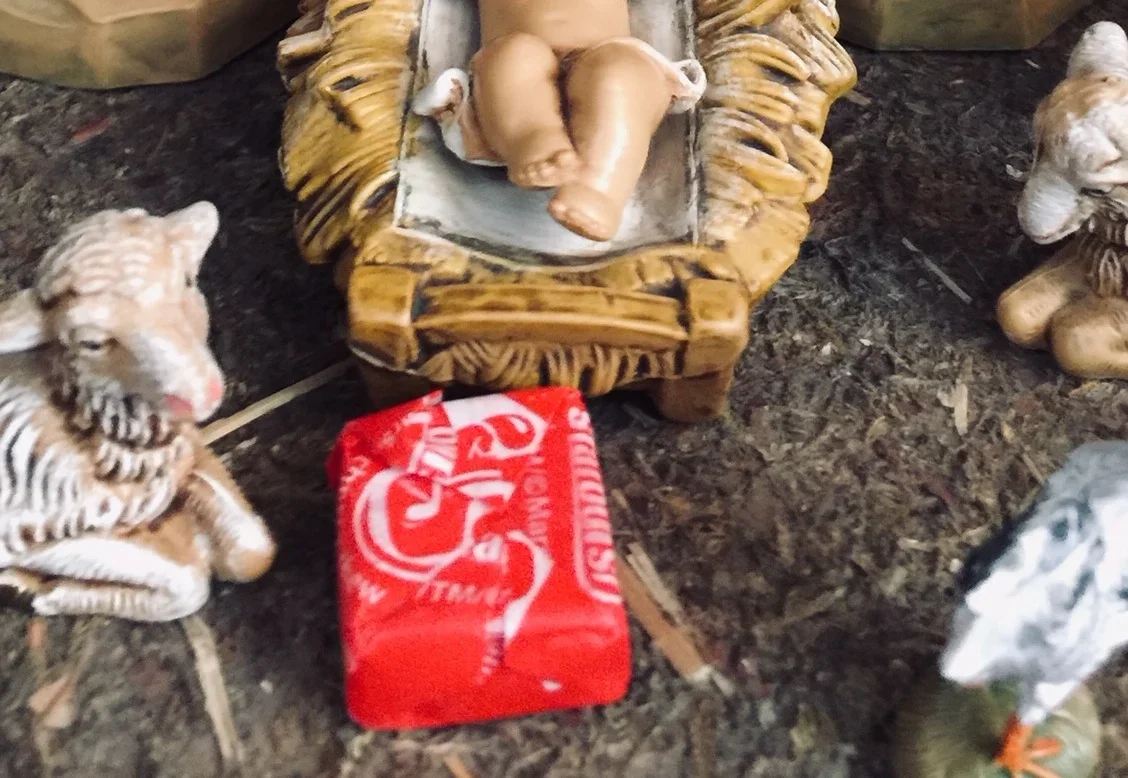
About a week after Christmas, Eli retrieved the candy from the manger and began to unwrap it. “He said I could have it,” Eli told me.

Epiphany: Come, Let Us Worship

“On entering the house they saw the child with Mary his mother. They prostrated themselves and did him homage. Then they opened their treasures and offered him gifts of gold, frankincense, and myrrh” (Matt 2:11).

 
One of the most opulent verses in all the Gospels, Matthew 2:11 overflows with action, color, and even wealth. Sophisticated men—wise men from the East—throw themselves on the ground before a little child. The profound worship of the magi astounds us.

Our English translations sometimes fall short of the original Greek’s power. To say the magi “knelt down” or “prostrated themselves” is fair. And to say they “did him homage” is rich enough. But truly, these men “fell down” (pesontes) and they “worshiped” (proskynesan). As deliberate as the magi apparently were, their act in the house of the Christ child was not entirely measured. Something overcame them and brought them to their knees.

It is hard to pin down exactly what it means to worship. But this single verse expresses it as well as anything. To worship something—to fall down before it, to submit entirely to it even with our bodies—is extraordinary, but also perfectly natural. It is to feel awe and wonder, to see and watch stars, to behold before us a presence, a person, a brother, a light. It is to know deep down in a place so instinctive that it is connected to our muscles and our memories that this One is sacred, and this One is kin. It is to know how close we have come to Glory.

Scripture often speaks of the face of God—how much we long for it (Ps 27:8), how dangerous it can be to gaze upon it (Exod 33:20), how light shines forth from it (Ps 4:6). Here, in the house of Jesus, in the arms of his mother, that light pours forth—brighter than anything we have ever seen before.

Come then, let us fall down! Let us return to him this gold, this Glory! Come, let us worship!

Adoration of the Magi, Kazimierz Sichulski

Lean into the Yearning: A Reflection for the Fourth Week in Advent


The following reflection refers to
the Mass readings found here.

* * * * * * * * * * * * * * *

The Bible can be a heartbreaking book. It’s about people, after all. Every story, every narrative, every parable—they may surprise and puzzle us, they may challenge us, but they always speak to something deep within us. We know these stories. We live them every day.

Today’s readings tell the stories of two couples who yearned so hard for something they did not have. They had no child. The painful word used to describe this situation is “barren.” We all know what barren means. It means lifeless, desolate, empty, dry. It means hopeless. It means heartbreak.

The yearning of the wife of Manoah, of Elizabeth and Zechariah, we feel it deep in our gut. We have all yearned this hard and come up barren. We have all felt dry and desolate. Barrenness is not only about the presence or absence of children. It is about being human. It is about yearning.

The sacred answer that emerges from this barrenness is the promise of divine faithfulness. And whether the promise is for children or salvation, it always leads to new life. This story of longing and fulfillment, of desiring and promising, of palpable need and abundant gift, is the story of the Bible from creation to gospel—from the barren earth, void and lifeless, to the incarnation, God-literally-with-us.

As Advent leans toward Christmas, we lean even harder into this yearning. And just there—on the horizon, where the days begin to lengthen—we can see it: a child is born, the fulfillment of all our yearning.

* * * * * * * * * * * * * * *

Amy Ekeh, “Lean into the Yearning” from the December 2022 issue of Give Us This Day, www.giveusthisday.org (Collegeville, MN: Liturgical Press, 2022). Used with permission.

A sun dog on a wintry day in central Minnesota. Photo by Hans Christoffersen.

This Is Christmas: A Reflection for the Season

Years ago as my family arrived at Mass on Christmas Eve, I told my son Julian to go find Jesus. “He’s up there,” I told him, pointing to the life-sized crèche at the front of the church. He shuffled up to the crèche, but he didn’t exactly linger. Determined that Julian and Jesus should have a prayerful moment, I sent him back. “Tell him happy birthday,” I said. Julian dutifully returned to the crèche. This time he stood before the manger for some time. I was pleased. Surely something special was happening.

But when Julian came back to the pew, he was pretty disappointed. “I told him,” he said sadly, “but . . . he wouldn’t even look at me.” I glanced up at the plaster statue at the front of the church. Julian was right. Baby Jesus was staring straight up, his glassy eyes fixed on the ceiling of the church.

Of course Julian and I both knew this was just a statue. It wasn’t Jesus. And yet I guess we both hoped for a connection, for something special, for the way we feel when loved ones look at each other. It’s only natural to yearn for that gaze.

Scripture is full of the language of looking—of humans looking for God (Ps 121:1), of God looking at us (Ps 33:13), of the intense glance of a lover toward the beloved (Song 4:9). It is this gaze that thrills us when God draws near. This is incarnation, this is Christmas—the uninterrupted gaze between ourselves and the divine—“what we have seen with our eyes, what we have looked at and touched with our hands” (1 John 1:1). This is no glassy-eyed, upward-gazing disconnect. This is the burning-without-hurting, the fullness-while-yearning that is God-with-us. This is Incarnation. This is Emmanuel. This is Christmas.

* * * * * * * * * * * * * * * * * * * * * * *

Merry Christmas, everyone!

Written for Little Rock Scripture Study 2021

An outdoor creche at Christ the Redeemer Church, Milford, CT

Open Hands

You open your hand and satisfy
the desire of every living thing.
—Psalm 145:16

To describe or even think about God, we rely on our own words and experiences. This means we are limited of course, and yet, what beautiful images we have! And what depth of experiences to draw upon.

The simple image from the psalm verse above—the image of God with open hands, providing for everything that lives and breathes, giving boundlessly to everything that desires—is such an image. I have experienced these outstretched hands. So have you. We’ve seen and touched them. We’ve received the gifts flowing from them, the generosity of God’s open hands.

And we’ve held our own hands open, in imitation of the God we love. We’ve outstretched them to our children, our students, our parishioners, and our coworkers, to friends, family, strangers, and spouses. We’ve kept them open longer than we ever thought we could. We’ve learned from covenants and crosses and stories of prodigal children to give more than was expected, to extend our hands deep into whatever inner stores we’ve kept and share whatever good we can find there. We’ve given till it hurts, and still we’ve kept our hands open.

This is the image I choose this Thanksgiving and Christmas, as these times stretch us and the challenges of the season await us. This is the image I choose—of a God with open hands, endlessly open, boundlessly open. Of me, remembering the times I’ve opened my hands and imitated the God I love. This is the image I choose—to stretch myself, to keep my hands open when I’m tired or disappointed, when what was supposed to be perfect isn’t, when there doesn’t seem to be enough. This is the image I choose—to keep my hands open, to imitate the God I love.

A Short Litany of Open Hands

God of open hands,
You care for the needs of every living thing.
Open my hands to imitate your love.

When there are needs to be met, open my hands.
When there is emptiness to fill, open my hands.
When there is work to be done, open my hands.

When I don’t think I can, open my hands.
When I’m willing but weak, open my hands.
When I’ve given my all, open my hands.

For the love of creation, open my hands.
For the joy of salvation, open my hands.
Without hesitation, open my hands.

God of open hands,
You care for the needs of every living thing.
Open my hands to join in your love.
Amen.

A drawing of open hands by Siobhan Ekeh.