Paschal Mysteries

“There have been times when, after long on my knees in a cold chancel, a stone has rolled from my mind, and I have looked in and seen the old questions lie folded and in a place by themselves, like the piled grave clothes of love’s risen body.”

 -- R.S. Thomas

Litany of the Sacred Heart of Jesus, Lover of Solitude

I’ve been wanting to share this litany for a while now, and the intensely prayerful season of Lent is the perfect time to do so!  This is not the typical “Litany of the Sacred Heart” that you find in most prayer books or around on the internet.  This litany comes from the “Saint Augustine’s Prayer Book,” a remnant from my Episcopal days and still one of my favorite prayer resources.  You’ll understand why when you read this litany!

As you pray it, reflect on the meaning of solitude.  Solitude is withdrawal from the world – it is quiet and peace, being alone, or being alone with someone you love.  You can seek solitude by going to a quiet place – or you can find it anytime by withdrawing into yourself and seeking only Christ, who waits for you patiently.  As you pray this litany, solitude just falls around you, or you fall into solitude.  Here you spend time with Jesus who loves solitude, and who loves you.

Please click the link below for a pdf of the litany to view or print:

Litany of the Sacred Heart of Jesus, Lover of Solitude

Behold, I stand at the door and knock.  If anyone hears my voice and opens the door, I will enter that house.  Revelation 3:20

Behold, I stand at the door and knock.  If anyone hears my voice and opens the door, I will enter that house.  Revelation 3:20

God and Storms

Do you ever pray about the weather?  “Pray for good weather this Sunday for the church picnic.”  While there’s certainly nothing wrong with praying for this sort of thing, it may create legitimate questions in our minds:  If God would arrange good weather for our church picnic, why wouldn’t he arrange for hurricanes to avoid heavily populated areas, or for monsoons to stop before they become devastating floods, or for rain to fall on drought-stricken farms?  Why not redirect a polar vortex or subdue a tsunami?

Can God control the weather?  Of course.  But does he?

In this way, earth’s storms are not unlike the storms of life.  We can and we should pray about the difficulties and devastations we face.  We must always communicate with, and lean on and believe in, our loving and powerful God.  But we are well aware that he does not always intervene when it comes to “bad weather.”  Could God control every aspect of our lives, create a wall around us, protecting us from every bad thing?  Perhaps.  But does he?  He most certainly does not.

Perhaps it comes down to a question of how God protects us.  There are times in life when we feel miraculously protected – walking away from a car accident, being thrown from a horse and standing up good as new.  But for the most part, we get tossed around by life with scars to show for it – there are injuries, illnesses, heartbreaks, sleeplessness, stress and death – for all of God’s children.  The rain falls on everyone, and some even seem to get more than their fair share.  God does not always shield us from these things.  And yet he remains our powerful protector.  He protects not with a power that interferes with each event, but a power that gathers us in, and pulls us near, and makes and keeps promises about being with us.  It is a power that may strike us as a bit too subtle at times, and yet as time passes, we recognize how awesome, and how essential, and how real it actually is.

As a parent, I do not want my children to suffer, and I am naturally tempted to smooth their paths in whatever way I can.  But even more than I may want an easy life for them, I want a great life for them.  I want them to be great.  And the fact is that great people have suffered.  They have experienced the storms of life without always bailing out into the nearest shelter.  They have learned the most important things by being brought down low.  Storms transformed them and made them strong, wise, clearheaded and serene.  Wounded?  Yes, that too.  But we can be wounded and still be great.  It is much harder to be utterly unscathed and be anything more than mediocre.

God allows bad weather – really bad weather – and he allows life’s storms.  Sometimes the storms are so bad that our wounds don’t heal.  For those times we may simply have to surrender:  “Lord, I know you may not change this storm, but you are always willing to change me.  So if you must, make me great!”

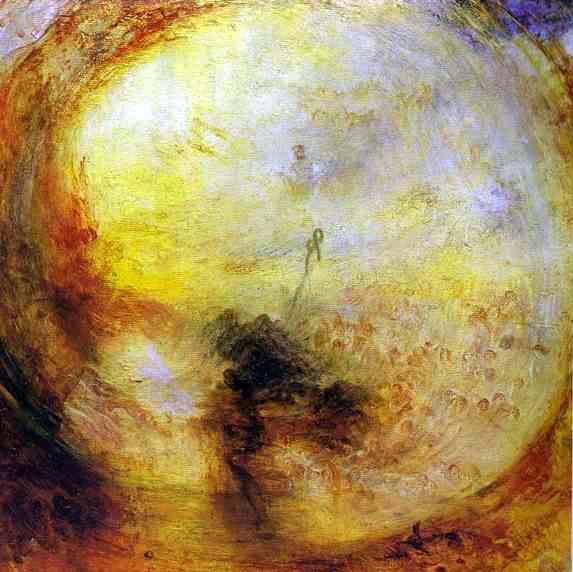
Light and Colour (Goethe's Theory) -- The Morning After the Deluge by William Turner, 1843.

Light and Colour (Goethe's Theory) -- The Morning After the Deluge by William Turner, 1843.

We Are Open Books

We don’t want to be “open books.”  We want to be in control of who knows what about us.  We try to hide the negative and the vulnerable.  We try to keep some events from our past hidden, some of our views to ourselves, and our deepest, darkest thoughts are tucked away in a place of our own making, never (we hope) to see the light of day, never to be judged by another, never to be held against us.  Even our spouses, our best friends, our parents, our children, do not know us fully.  We do not allow it.  We do not want it.

But is that true?  Or do we really want to be known?  After all, we can’t be fully loved unless we are fully known.  We may be loved by another – but what about our “secret selves” – the part they don’t know about, the part we hide?  Do they love that, too?  How can they, if they are unaware of it?

To be an open book can be frightening.  But ultimately it is what we want.  We want to be fully known because we want to be fully loved.  We fear rejection, but we want to be free of that fear.  In this life, we may never be completely free of the fear that others will reject us.  But could we possibly believe that God has seen all those hidden places, knows our “secret selves”?  And still loves us?

As a former Episcopalian, I still hear the echoes of the beautiful liturgies and prayers of that time in my life.  One of those prayers remains a personal favorite.  It is a prayer offered at the beginning of the Eucharistic liturgy, and it basically says, “God, I give up.  I’m not trying to hide anything from you.  You know things about me that I won’t even admit to myself.  You know everything about me and I’m glad, I’m relieved.  Now cleanse my heart and mind so I’m free of my blindness, burdens and dirt, free to worship and love you.”

Almighty God, unto whom all hearts are open, all desires known, and from whom no secrets are hid, cleanse the thoughts of our hearts by the inspiration of thy Holy Spirit, that we may perfectly love thee and worthily magnify thy Holy Name; through Christ our Lord.  Amen.

When Jesus Asks a Question

Have you ever noticed that Jesus asked a lot of questions?  It is one of the ways he taught and preached (“Is there anyone among you who, if your child asks for bread, will give him a stone?” Mt. 7:9).  Questions are also a hallmark of Jesus’ encounters with individuals (“Simon, son of John, do you love me more than these?” Jn. 21:15).  In fact, the Gospels record more than one hundred questions asked by Jesus!  (See Msgr. Charles Pope’s compilation of “100 Questions Jesus Asked and You Must Answer.”)

Questions have an effect on us that answers do not.  They draw us in.  They create space for a natural process of reflection and learning rather than a quick and easy leap to pat answers.  They invest us in our own answers, or in our own search for answers.  The answers we come to on our own ultimately mean more to us than the answers someone else provides (consider, for example, the classic question:  “Who do you say that I am?”).  Jesus did not need to be educated in the Socratic Method to know this.  He only needed to understand human nature.

There are times and circumstances in life when one or another of Jesus’ questions will pierce us to the heart.  On Saturday at Mass, I was struck by a question Jesus asks in the Sermon on the Plain:  “Why do you call me ‘Lord, Lord’ and do not do what I tell you?” (Lk. 6:46).  We could certainly ask ourselves that one on a daily basis.

Here are a few more of Jesus’ questions to ponder.  Each one can be an occasion for prayer, an opportunity for self-reflection, or just an honest moment between yourself and the One who is asking: 

 Why are you afraid? (Mt. 8:26)

 What do you want me to do for you? (Mt. 20:32)

 Do you believe that I can do this? (Mt. 9:28)

 If I am telling you the truth, why do you not believe me? (Jn. 8:46)

 Have I been with you for so long and still you do not know me? (Jn. 14:9)